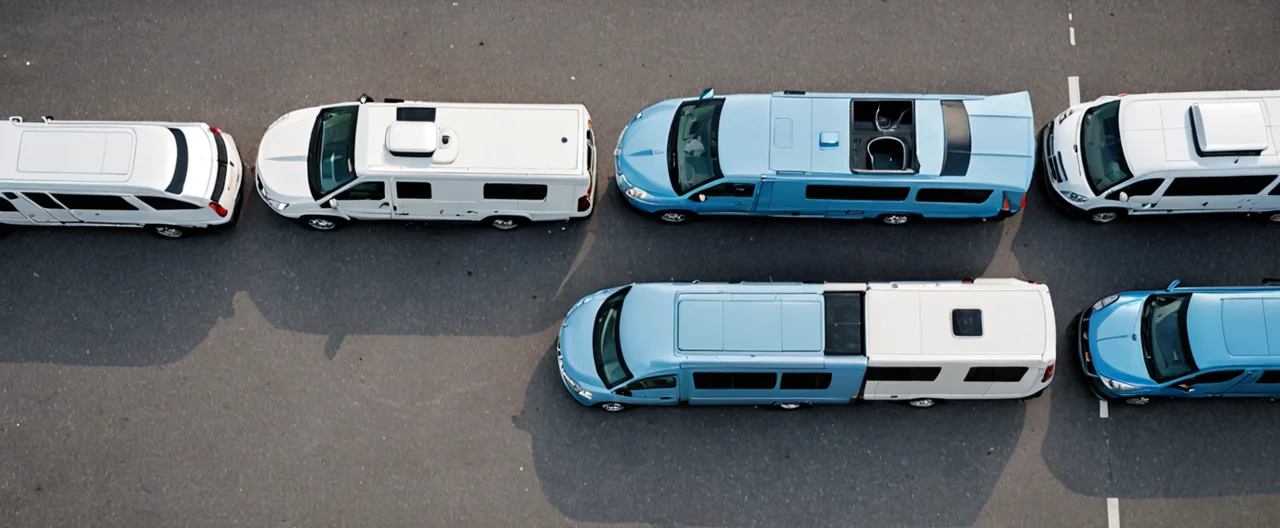
Campground length limits are measured on the combined vehicle length — motorhome plus towed car, or truck plus trailer — and they are enforced, not advisory. Yellowstone's Madison Campground and Fishing Bridge RV Campground both publish a 40 ft combined limit; Olympic's Kalaloch publishes 35 ft and Heart o' the Hills publishes 21 ft. A 30 ft travel trailer behind a full-size pickup is already over 40 ft combined, which puts Madison and Fishing Bridge out of reach and leaves Kalaloch tight. The single most useful thing you can do before booking any public campground is measure your rig hitched up, bumper to bumper, and compare that number — not the box length on your registration — against the published limit.
Combined length is the number that decides where you can stay
Public campground limits are almost always written for the whole combination, which means the tow vehicle or toad counts. A Class C motorhome that measures 28 ft on its own is a different booking than the same coach flat-towing a compact SUV behind it. The published limit doesn't care how you got there; it cares what's occupying the pad and the access road at the same time.
The practical failure mode is booking on the coach length, arriving, and being turned around at the entrance station. That happens most at older campgrounds built for tents and short trailers, where the road curves between trees and the pad sits at an angle. Heart o' the Hills at 21 ft combined is the clearest example in the national park system — that's a limit that excludes nearly every motorhome and most truck-and-trailer combinations, and it exists because the road and sites physically can't take more. Kalaloch at 35 ft is generous by comparison but still shuts out a long fifth wheel or a big Class A with a towed vehicle. Madison and Fishing Bridge at 40 ft accommodate a lot, but a 35 ft travel trailer behind a crew-cab pickup blows past it.
Measure the combination on flat ground with the trailer hitched and loaded, not empty. Tongue weight, cargo in the bed, and a loaded water tank all change the number slightly, and the measurement that matters is the one on the day you arrive. If you're within a foot or two of a published limit, treat it as over — site assignment is done by staff who eyeball the rig, and a strict campground will hold you to the number. The cost of getting this wrong is a cancelled reservation and a long drive to find somewhere else, often in a park with no cell signal at the entrance.
Hookups, pad surface, and site length are three separate questions
A site listed as "fits 40 ft" may have no hookups, may be gravel, and may be unlevel enough that a Class A needs blocks under the jacks. These are independent attributes, and campground listings collapse them badly. Read the site description line by line: electric, water, sewer, and pad type are each stated separately, and "no hookups" at a national park campground usually means a dump station at the entrance and a water fill, not a spigot at the site.
Fishing Bridge is the outlier in Yellowstone because it's the one campground in the park with full hookups, which is why it books out far earlier than the others and why its 40 ft limit gets tested by every large coach in the park. Madison has no hookups and a 40 ft limit, so it suits a self-contained rig with decent tank capacity and a generator or solar setup. The trade-off is real: full hookups mean you can run the air conditioner, the microwave, and the water heater without thinking, and no hookups mean every appliance is a draw on a finite battery bank and propane supply.
Pad surface changes what you can level. A gravel or dirt pad on a slope may need more blocking than a paved one, and some sites are crowned or sloped enough that a long wheelbase coach can't get the refrigerator level without ramps. Site photos, when they exist, are more reliable than the length number. When they don't, call the campground directly — entrance station staff and camp hosts know which sites are level and which are tight, and that information rarely makes it into the reservation system.
Booking windows and cancellation rules vary by agency, not by park
Reservation windows are set by the managing agency, so two campgrounds in the same park can have different rules if one is run by the National Park Service and the other by a concessioner. Yellowstone's campgrounds are a mix, and Olympic's are too. The window that applies is the one on the booking page for that specific campground, and it changes — agencies have revised windows and cancellation policies repeatedly in recent years.
What matters more than the window is the cancellation and no-show policy, because that's where money is lost. Most agency systems charge a cancellation fee that scales with how close to arrival you cancel, and a no-show forfeits more than a timely cancellation. Booking a flexible site you might not use as a placeholder is the expensive habit here. The other habit worth having is checking for released cancellations in the days before arrival — sites get dropped constantly as people's plans change, and the booking systems release them back into inventory immediately.
The concessioner-run campgrounds often have different rules again, sometimes with a longer booking window and a separate cancellation schedule. If you're planning a multi-stop trip through several parks, expect to manage several booking systems, several windows, and several fee schedules. There's no single pass that covers them, and the annual public-lands pass that covers entrance fees does not cover camping fees.
What each rig class gains and loses at a public campground
Rig class determines which campgrounds are even open to you, and the shorter the rig, the more of them there are. That's the whole calculus, and it's worth understanding what you're giving up at each end.
| Rig type | What it gains at public campgrounds | What it costs |
|---|---|---|
| Class B motorhome (camper van) | Fits under almost every length limit, including tight ones like Heart o' the Hills; no toad to disconnect; easy maneuvering on narrow roads | Smallest tank capacities, so limited dry camping duration; cramped for more than two people; less storage for gear |
| Class C motorhome | Cab-over bed adds sleeping space without adding much length; fits many 35–40 ft limits when not towing | Towing a car pushes combined length past many limits; the cab-over adds height that matters under tree branches |
| Class A motorhome | Largest living space and tank capacity; best for extended stays at full-hookup sites like Fishing Bridge | Longest combined length with a toad; excluded from strict campgrounds; needs the widest roads and pads |
| Travel trailer | Unhitch and the tow vehicle becomes your runaround, so you don't need a separate toad | Combined length with the truck is what counts, and it often exceeds 40 ft; hitching and leveling at every stop |
The travel trailer's unhitch advantage is real and underrated — you arrive, drop the trailer, and drive the truck into the park without a second vehicle. But the combined length is measured hitched, and a long trailer behind a full-size truck is the combination most likely to run afoul of a 40 ft limit. A Class B is the opposite trade: it fits everywhere and holds almost nothing. The honest middle is a Class C without a toad, or a shorter travel trailer behind a half-ton truck, measured before booking.
Height matters as much as length and gets far less attention. Tree branches, tunnel clearances, and campground entrance arches are the usual culprits, and a cab-over or a roof-mounted air conditioner adds height that a length limit won't warn you about. If your rig is tall, check clearance before committing to a campground with a lot of mature trees.
Winterizing and shoulder-season camping change what a park guide has to tell you
A travel trailer's water system needs RV-specific antifreeze rated for the cold it will see, and the common product rating is burst protection to -50 °F. That figure describes the antifreeze, not your plumbing — the protection only holds if the lines are fully drained of water first and the antifreeze is run through every fixture, including the toilet valve, the water heater bypass, and the outdoor shower. Antifreeze diluted by water left in the lines protects to a much warmer temperature than the label says.
The sequence matters: drain the fresh tank and water heater, blow the lines with air if you have a compressor, bypass the water heater, then pump antifreeze through until it runs pink at every tap, including the low-point drains. Skip the water heater bypass and you'll fill a six- or ten-gallon heater with antifreeze you didn't need to buy. Skip the toilet valve and that's the part that cracks. The cost of doing it properly is a couple of gallons of antifreeze and an hour; the cost of doing it badly is a burst line behind a cabinet panel.
Shoulder-season camping at public campgrounds is a different proposition than summer. Many campgrounds close or drop to limited loops and vault toilets outside peak season, water systems get shut off before the first hard freeze, and the sites that remain open may have no water available at all. That changes your planning: you carry your own water, you rely on your tanks, and you winterize or keep the system charged depending on the overnight lows. A campground that's open in October may still have its water off, and the listing doesn't always say so. Call ahead.
The other shoulder-season variable is that length limits don't change with the season, but site availability does. A campground with a 40 ft limit in July may have only a handful of loops open in November, and those loops may not include the long pull-through sites. Booking late in the year means checking which loops are open, not just whether the campground is.
Matching the guide to the trip you're actually taking
Start with the combination length, because it eliminates campgrounds faster than any other filter. Measure hitched and loaded, add a margin, and treat anything within a foot or two of a published limit as a no. Then filter on hookups: a rig with a small battery bank and no generator needs electric or full hookups for anything beyond a night or two, while a rig with solar and a big fresh tank can dry camp comfortably at a no-hookup campground like Madison.
After that, the questions get softer but still matter. Pad surface and levelness decide whether setup takes ten minutes or forty. Booking window and cancellation policy decide how much of your planning has to happen months out and how much money you risk on a change of plans. Season decides whether water is available and which loops are open. Height clearance decides whether the entrance road is passable at all.
The guide that serves you is the one that answers those in the order you'll actually hit them — length first, because it's binary and unforgiving, then hookups and pad, then booking mechanics, then season. A campground that fails the length check doesn't need its hookup details read. A campground that passes it but has no water in October needs that fact before you book, not after you arrive with an empty tank.
The limits themselves are published per campground and change, so the number on any listing is a snapshot. Yellowstone's 40 ft at Madison and Fishing Bridge and Olympic's 35 ft at Kalaloch and 21 ft at Heart o' the Hills are the figures to plan against, but confirm against the current listing before you commit, especially at the strict end where a foot matters. The rig you drive decides most of this before you ever open a booking page — which is why the measurement comes first and everything else follows from it.