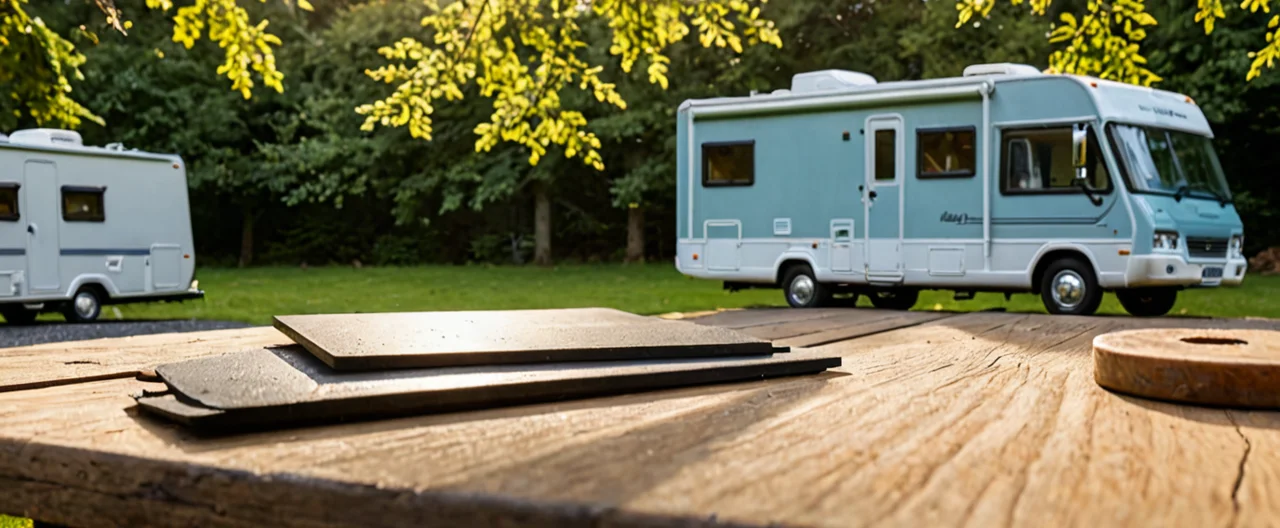


Park reviews are the only part of trip planning where the campground's own rules and a stranger's recent stay both matter, and the reviews that help you are the ones that answer three questions in order: will my rig physically fit, will I get a spot, and what will the stay actually be like. Everything below is about how to read, filter, and trust those reviews — and where they mislead you.
Length limits are published as combined vehicle length, and that is the first thing to check in any review
The number a park publishes for RV length is almost always combined vehicle length — motorhome plus towed vehicle, or truck plus trailer — not the length of the box you sleep in. A review that says "fits 30-footers fine" tells you nothing until you know whether that reviewer was towing. Treat every length claim in a review as unverified until it names the combined figure and the site number.
The published limits themselves are a good calibration for how seriously to take this. In Yellowstone, Madison Campground and Fishing Bridge RV Campground both publish a typical limit of 40 ft combined as of 2026. In Olympic, Kalaloch publishes 35 ft combined, and Heart o' the Hills publishes a strict 21 ft combined. That last one is the useful example: a 21 ft combined limit excludes most Class C motorhomes and nearly every truck-and-trailer combination in normal use, and it is not negotiable at the gate. Reviews of Heart o' the Hills that mention "plenty of room" are almost certainly written by someone in a Class B camper van or a very short trailer, and the review format rarely makes that obvious.
This is where rig type does the sorting for you. A Class B motorhome is a van body with the original cab intact and living space packed inside it — the shortest self-propelled option and the one that clears tight limits. A travel trailer is towed and its combined length includes the tow vehicle, so a modest trailer behind a full-size truck can approach the same combined figure as a much larger motorhome. A Class C has the cab-over section and a cutaway van or light truck chassis; a Class A is the bus-shaped body on a bus or heavy commercial chassis and is the hardest to place in older, tree-lined parks regardless of what the sign says.
The cost of getting this wrong is a turned-away arrival, and it happens most at parks with interior roads laid out before large RVs existed. Read the length limit on the park's own page first, then use reviews to find out whether the limit is enforced strictly or whether the real constraint is a low branch or a tight turn at the dump station. Reviews are better at the second question than the first.
Separate reviews of the campground from reviews of the reservation system
A large share of one-star campground reviews are complaints about booking, cancellation, fees, or a host's attitude, and those tell you nothing about whether site 42 is level. Read the star rating as a blend and go straight to the text for the things that are physical: pad surface, slope, hookup placement, shade, road noise, cell signal, and distance to the thing you came for. A campground with a miserable booking process and excellent sites is a real category, and the aggregate score hides it.
The same applies in reverse. A park with a beloved host and a gorgeous setting can carry a high average while every site on the outer loop is exposed and wind-scoured. Reviews written in July about shade are worth more than reviews written in January about the same park, and reviews that mention the specific loop or site number are worth more than reviews that describe the campground as a whole.
The honest limitation: review volume is thin at the parks where the information matters most. Remote public campgrounds and small municipal parks may have a handful of reviews across several years, and those few may all be from tent campers. When the sample is that small, weight the park's published rules and a current map above any individual review, and treat the reviews as color rather than fact.
Hookups, pad type, and site dimensions are the details reviews exist to supply
Public campground listings tell you whether a site has electric, water, and sewer, and almost nothing about whether your 30-amp cord reaches the pedestal from where you can actually park. Reviews fill that gap when they are specific. The phrases that carry real information are the ones with a direction and a distance: "pedestal on the wrong side," "back-in with a drop at the entrance," "water spigot shared between two sites," "sewer connection uphill from the pad." Vague praise — "nice site," "great spot" — carries none.
What to look for, in rough order of how much trouble it saves:
- Pad surface and levelness, and whether leveling blocks were needed at a specific site.
- Hookup side and reach — which side of the rig the pedestal sits on and whether an extension cord or extra hose was required.
- Overhead clearance and tree cover, which matters more than length at older parks and is almost never published.
- Whether the site is pull-through or back-in, and how tight the approach is for a long rig.
- Noise sources named specifically: a highway, a train line, a generator loop, a nearby amphitheater.
- Cell signal by carrier, with the caveat that it changes.
The trade-off with hookup-heavy reviews is that they skew toward big rigs and full-hookup loops. If you are in a camper van or a small trailer and you want the quiet outer loop with no services, the reviews that rave about 50-amp service are describing a different campground than the one you are booking. Filter for your rig type and your loop, or the reviews will quietly push you toward the least interesting part of the park.
Season, weather, and closures change the answer more than any review does
A review is a snapshot of one set of dates, and the same site can be a mud pit in spring and a dust bowl in late summer. Read the date on every review before you read the content, and discount anything older than a couple of seasons for anything that can be renovated, re-graded, or re-staffed. Campgrounds change hands, loops get repaved, and a review from several years back about a broken shower house may describe a building that no longer exists.
Winter matters differently depending on what you are reviewing. If you are evaluating a park for a cold-weather stay, the review should tell you whether water is shut off, whether the dump station is open, and whether the loop you want is plowed. None of that is in a summer review. If you are winterizing your own trailer before the trip, the RV-specific antifreeze you use is rated for burst protection to -50 °F as of 2022, and a park review that mentions hard freezes is worth more than a general weather average.
Closures are the failure mode reviews catch late and park pages catch early. A loop closed for construction, a bridge out on the access road, a fire ban, a reservation system change — check the park's own current notice first and use reviews to find out how the closure is actually affecting people on the ground. Reviews run behind reality by weeks at busy parks and by months at quiet ones.
Reservation mechanics and arrival timing decide whether the review ever applies to you
The best-reviewed site in the park is useless if you cannot get it. Before you read a single review, know how that park allocates sites: fully reservable, partly reservable with a walk-up share, or first-come first-served. Reviews that mention "got here at noon on a Thursday and had our pick" are describing a first-come system, and that information expires the moment the park changes its policy or the season turns busy.
Arrival timing is the second half of it. Reviews that name a specific arrival time alongside a specific date and a specific outcome — a site taken, a loop full, an overflow area opened — are the most useful reservation data a camper can get, precisely because parks rarely publish how fast a loop fills. Reviews that say "book early" say nothing. Reviews that say which loop filled first and by what time of day tell you what to do.
The trade-off is that these reviews are the most perishable kind on the page. A first-come park that was easy three seasons ago may now be a scramble, and a park that just moved to full reservation may have a year of stale advice attached to it. Read reservation-mechanics reviews newest first and treat anything from a previous season as a hypothesis rather than a plan. The cost of being wrong here is a night in a Walmart parking lot, which is survivable but not what you drove for.
How much to trust a review, and when to overrule it
Trust a review most when it is specific, recent, and written by someone with your rig type; trust it least when it is emotional, undated, or describes a stay that could have been at any campground in the country. A review that names the site, the dates, the rig, and one concrete problem is worth a dozen five-star entries that say "beautiful, will be back." The single most reliable signal in a park review is a complaint about something physical that the reviewer could have checked in advance — that tells you they were paying attention.
There are cases where the reviews should be overruled outright. Published length limits are the clearest: no number of reviews saying "our 38-footer fit fine" changes a 21 ft combined limit at a park like Heart o' the Hills, and the reviews that claim otherwise are usually from people who measured wrong or arrived when the gate was unattended. Park rules on generators, fires, pets, and quiet hours are the same — a review that says "nobody enforced it" is not permission, it is a warning that enforcement is inconsistent.
What reviews are genuinely better at than any official source is the texture of a stay: which loop is quiet, which sites catch afternoon sun, where the road noise comes from, whether the showers are worth using or you should rely on your own. Use the park's page for the hard constraints — length, season, reservation system, hookups — and use reviews for everything the park has no reason to publish. A trip planned that way survives the drive, the gate, and the first night, which is more than most itineraries manage.
Sites that reviewers call "big rig friendly" often aren't, and the site number is the tell
A review that names a specific site and the rig that fit it is worth ten that rate the campground as a whole, because site-to-site variation inside one loop routinely exceeds the variation between parks. The failure pattern is consistent: someone in a Class B camper van calls a campground spacious, a Class A owner books the same loop on that basis, and the constraint turns out to be a turn radius at the loop entrance rather than the pad itself. When you read reviews, sort by rig type before you sort by star rating. A complaint from a travel trailer about the approach angle into a back-in site is a different piece of information than a complaint from a motorhome about the same site, and the two rarely appear together.
Overhead clearance deserves its own search. Published limits cover length and almost never mention the branch over the site or the low utility line at the dump station, and those are the things that stop a tall rig where the sign said it would fit. Reviews that mention trimming, scraping, or a specific tree are the only place this shows up. The trade-off is that these reviews are rare and often buried — search the text for words like "branch," "low," and "scrape" rather than reading the top-rated entries, which tend to be written by people who had an uneventful stay.
Photos and site-specific search beat the star average every time
Search the review text for a site number before you read anything else, then look at the photos attached to that site rather than the ones in the park's gallery. A photo of the actual pad tells you slope, surface, and where the pedestal sits in one glance, and it is the single fastest way to rule a site out. The limits of this are real: photos skew toward photogenic sites and good weather, few reviewers photograph the awkward approach road, and a wide-angle phone shot makes a tight back-in look generous. Treat a photo as confirmation of what a written review claimed, not as a substitute for it.
The star average is the least useful number on the page and the one most people read first. It blends booking complaints, weather, host disputes, and site quality into a single figure that answers a question nobody asked. Read the newest reviews with photos, search for your rig type and your site number, and let the average go. The cost of doing it this way is time — a thorough read of a busy park's reviews takes longer than scanning scores — and at a park with a handful of reviews, there is nothing to search and the published rules and a current map are all you have.